Brighton Bathing Boxes
Melbourne's iconic painted beach huts
On the lands of the Bunurong (Boonwurrung) people people.
schedule 2 min read / Updated Jun 2026
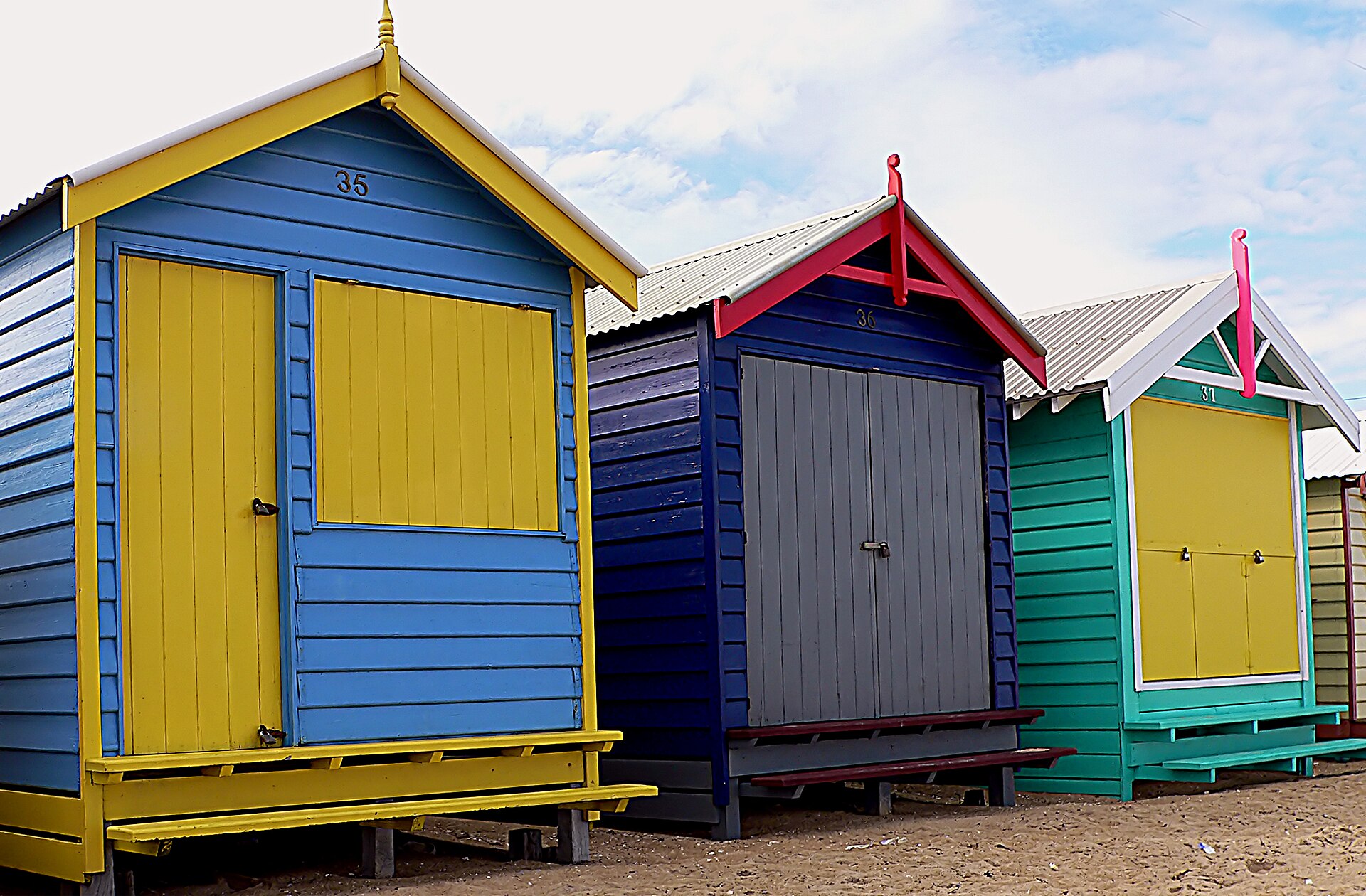
Stretching in a vivid row along Dendy Street Beach in Brighton, the 82 heritage-listed timber bathing boxes are one of Melbourne's most photographed landmarks. Privately owned by Bayside residents since the 1860s, these compact huts sit on the foreshore of Port Phillip Bay with the city skyline as a backdrop, offering a free and endlessly colourful spectacle for visitors year-round.
The Brighton Bathing Boxes trace their origins to the strict modesty laws of the Victorian era, when changing on the beach was forbidden and bathers needed enclosed spaces to dress. The first boxes appeared along the Brighton coastline in the 1860s, and by the early twentieth century demand had surged, the arrival of the electric tram from St Kilda in 1906 sparked a wave of new applications and construction between 1908 and 1911. At their peak, hundreds of boxes lined Brighton's beaches.
During the Great Depression in 1934, scattered boxes across multiple Brighton beaches were consolidated and relocated to Dendy Street Beach to allow construction of a bluestone foreshore promenade. This concentration saved them from piecemeal loss and gave the site its distinctive uniform character. By 1952, government authorities pushed for their removal entirely, but the Brighton Bathing Box Association mounted a successful campaign for their preservation.
Today the boxes are exclusively owned by Bayside residents, who hold annual site licences issued by Bayside City Council. The boxes cannot be rented out commercially, they serve as private changing rooms and beach-equipment storage. They are not connected to water or electricity. Ownership occasionally changes hands at auction, with prices having risen from around $58,000 in 2000 to upwards of $400,000 in recent years, reflecting their cultural cachet.
The row is protected under the Victorian Planning Scheme Heritage Overlay and was heritage-listed by Bayside City Council in July 2000. The overlay mandates a uniform external form, painted weatherboards and corrugated iron roofs, but permits owners to choose their own colour schemes and decorative motifs. The result is an ever-changing gallery of geometric patterns, maritime themes, footy club colours, and bold abstract designs that draws photographers from around the world.
The beach sits on the Country of the Bunurong (Boonwurrung) people, who have lived along this coastline for thousands of years. Shell middens and stone artefacts remain in the dunes behind the bathing boxes at Dendy Street Beach, evidence of continuous occupation long before European settlement. The foreshore is an area of high Aboriginal cultural sensitivity protected under both State and Federal legislation. Visitors can view the boxes freely from the beach at any time, with the best light for photography in the early morning, when the boxes face the rising sun and the Melbourne skyline is visible across the bay.
Common questions
Things visitors ask about Brighton Bathing Boxes.
Quick answers to help you plan.
Is there an entry fee to see the Brighton Bathing Boxes?
expand_more
No. The bathing boxes are on a public beach and are completely free to view at any time of day. There are no gates or ticketing. Parking at the nearby Bayside City Council car parks is paid, and public transport via the Sandringham train line is the easiest option.
Can I rent or stay inside one of the bathing boxes?
expand_more
No. The boxes are privately owned by Bayside residents and cannot be rented to visitors or the general public under the conditions of their Bayside City Council site licences. They are used solely as private changing facilities and beach-equipment storage by their licensed owners.
What is the best time of day to photograph the bathing boxes?
expand_more
Early morning is ideal. The boxes face east, so sunrise light falls directly on their colourful facades. The bay is often calm in the morning and the Melbourne CBD skyline is visible in the background, providing a classic composition. Summer mornings also allow photography before the beach gets crowded.
How do I get to the Brighton Bathing Boxes by public transport?
expand_more
Take the Sandringham line from Flinders Street Station to Brighton Beach Station or Middle Brighton Station. From Brighton Beach Station, a scenic 500-metre walk along the foreshore coastal art trail leads to the boxes. Buses also service the area from St Kilda.
When were the Brighton Bathing Boxes first built?
expand_more
The first bathing boxes appeared along the Brighton coastline in the 1860s, when modesty laws prevented changing on the beach. Most boxes now on Dendy Street Beach were built in the early twentieth century. They were relocated to their current consolidated position in 1934 during construction of the foreshore promenade.
Who are the traditional owners of this area?
expand_more
The Bunurong (also known as the Boonwurrung) people are the traditional owners of the land along this stretch of Port Phillip Bay. They have maintained a connection with this coastline for thousands of years. Shell middens and stone tools left by the Bunurong remain in the dunes behind the bathing boxes today.
Are the bathing boxes at risk from coastal erosion?
expand_more
Yes, erosion is an ongoing concern. Some boxes have required sandbag protection and Bayside City Council has overseen beach sand replenishment works to protect the foreshore. The heritage overlay protects the structures themselves, but the broader challenge of coastal erosion requires active management of the beach environment.
Gallery
Brighton Bathing Boxes in pictures.
6 images licensed from Wikimedia Commons
All images are sourced from Wikimedia Commons under Creative Commons licences. Individual photographers are credited on the source pages.
Scenic views
Lookouts near Brighton Bathing Boxes.
You may also like




Attribution
Sources & credits
Content (4)
- Wikipedia: Brighton Bathing Boxes · CC BY-SA 4.0
- Brighton Beach Bathing Boxes · Bayside City Council
- History and timeline - Brighton Bathing Box Association · Brighton Bathing Box Association
- Brighton Bathing Boxes - Wikipedia · Wikipedia contributors · CC BY-SA 4.0
Images (6)
- Bathing boxes at Port Phillip Bay, Australia; 2005.jpg · Bernard Spragg. NZ from Christchurch, New Zealand · CC0
- PXL 20241005 062211747.MP Brighton Bathing Boxes Esplanade,... · Sourabh.biswas003 · CC BY-SA 4.0
- PXL 20241005 062211747.MP Brighton Bathing Boxes Esplanade,... · Sourabh.biswas003 · CC BY-SA 4.0
- PXL 20241005 062211747.MP Brighton Bathing Boxes Esplanade,... · Sourabh.biswas003 · CC BY-SA 4.0
- PXL 20241005 062211747.MP Brighton Bathing Boxes Esplanade,... · Sourabh.biswas003 · CC BY-SA 4.0
- PXL 20241005 062211747.MP Brighton Bathing Boxes Esplanade,... · Sourabh.biswas003 · CC BY-SA 4.0


Images sourced from Wikimedia Commons under licenses that permit commercial use. If you are the rights holder and believe an attribution is incorrect, please contact us.