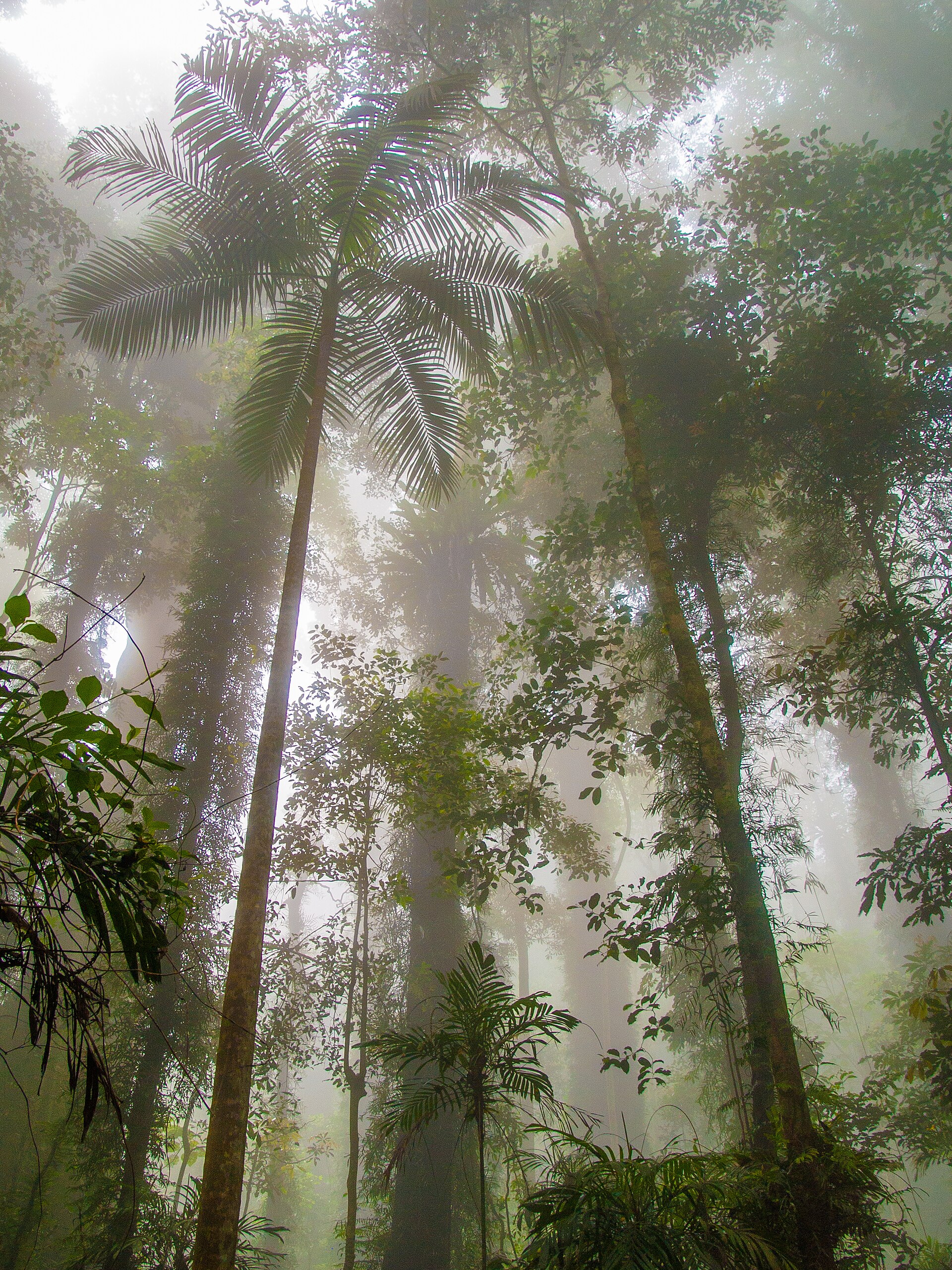
Dorrigo National Park
Dun Durriga
Ancient rainforest above the clouds
On the lands of the Gumbaynggirr people people.
schedule 2 min read / Updated Jun 2026
Perched on a misty escarpment above the Coffs Harbour coastal plain, Dorrigo National Park protects 11,900 hectares of World Heritage subtropical and warm-temperate rainforest. The park's elevated Skywalk boardwalk carries visitors above the ancient canopy, while the legendary Wonga Walk threads past tumbling waterfalls and 600-year-old trees, all within an hour's drive of Coffs Harbour along the scenic Waterfall Way.
Dorrigo National Park sits within the Gondwana Rainforests of Australia World Heritage property, first inscribed in 1986 and extended in 1994, one of the most significant temperate and subtropical rainforest ecosystems on Earth. The park covers 119 square kilometres of the Dorrigo Plateau, rising steeply from the coastal lowlands to elevations where cool mist clings to the canopy through much of the year. Its position on the escarpment creates the exceptional rainfall that sustains these ancient forests, which are living remnants of the vast rainforests that once blanketed the Gondwana supercontinent.
The Dorrigo Rainforest Centre serves as the gateway to the park and houses the interactive Rainforest Revealed exhibition. From the centre, the elevated Skywalk boardwalk launches visitors above the tree canopy for sweeping views stretching all the way to Coffs Harbour and the Pacific Ocean. The experience of standing above a living forest, with fruit-doves calling beneath your feet and brushturkeys moving through the understorey, is one of the most memorable in coastal New South Wales.
The Wonga Walk is the park's signature trail: a 6.6-kilometre loop through World Heritage-listed rainforest taking roughly two to three hours to complete. The track winds past towering strangler figs, dense mossy undergrowth, and the extraordinary Crystal Shower Falls, where a suspension bridge delivers walkers directly in front of the cascading water. A short side track leads behind the falls into a rocky cavern, allowing visitors to peer out through the veil of falling water, a highlight that particularly captivates children and photographers alike. Tristania Falls is another waterfall encountered along the route.
The park supports remarkable biodiversity: approximately 30 mammal species, 128 bird species, and 44 reptile and amphibian species. Red-necked pademelons graze at the forest edges at dusk, while the vibrantly coloured wompoo fruit-dove and the striking regent bowerbird are among the most sought-after sightings for birdwatchers. The superb lyrebird, renowned for its extraordinary mimicry, inhabits the cooler gullies. Spring and autumn are the most rewarding seasons to visit, offering mild temperatures and the best wildlife activity, though the rainforest is beautiful in all seasons.
The Dorrigo Rainforest Centre requests a $2 donation for entry, which supports the park's interpretation and conservation programs. The park itself is free to enter and remains open year-round, though the Rainforest Centre closes on Christmas Day and operates reduced hours between June and August. Visitors should come prepared for sudden rain at any time of year, as the escarpment climate is famously unpredictable, and sturdy footwear is essential for the walking tracks.
Common questions
Things visitors ask about Dorrigo National Park.
Quick answers to help you plan.
Is there an entry fee for Dorrigo National Park?
expand_more
The national park itself is free to enter and open year-round. The Dorrigo Rainforest Centre requests a $2 donation per person, which helps fund interpretation and conservation programs. Parking at the Rainforest Centre is also free. The centre is open daily from 9am to 4:30pm (September to May) and 9am to 3:30pm (June to August), and is closed on Christmas Day.
What is the Skywalk and how long does it take?
expand_more
The Skywalk is an elevated boardwalk that extends from the Dorrigo Rainforest Centre above the rainforest canopy, offering views across the forest and coastline to Coffs Harbour. It takes around 15 to 30 minutes to walk and is suitable for wheelchairs and prams. It is one of the most accessible and rewarding experiences in any Australian national park.
How long is the Wonga Walk and is it suitable for children?
expand_more
The Wonga Walk is a 6.6-kilometre loop through World Heritage rainforest, taking approximately two to three hours. It is rated Grade 2 with some steeper sections, steps, and boulder crossings, suitable for older children and reasonably fit adults. The highlight is Crystal Shower Falls, where you can walk behind the waterfall, which children find particularly exciting.
Who are the traditional owners of Dorrigo National Park?
expand_more
The park lies within Gumbaynggirr Country. The Gumbaynggirr people have a deep and continuing connection to this landscape. The name Dorrigo is believed to derive from Dun Durriga, the Gumbaynggirr word for the tallowwood trees that grow throughout the area.
What wildlife might I see at Dorrigo?
expand_more
The park supports 128 bird species and 30 mammal species. Common sightings include red-necked pademelons (especially at dusk near the picnic areas), superb lyrebirds, and the striking regent bowerbird. Birdwatchers particularly prize the wompoo fruit-dove for its vivid plumage. The Wonga Walk and Walk with the Birds boardwalk offer the best wildlife viewing opportunities.
Can I visit Dorrigo National Park as a day trip from Coffs Harbour?
expand_more
Yes, Dorrigo is approximately 70 kilometres and about an hour's drive from Coffs Harbour along the Waterfall Way. A comfortable day trip allows time for the Skywalk, the Crystal Shower Falls walk, and the full Wonga Walk. Two days is recommended if you want to explore additional tracks such as Red Cedar Falls and the Never Never picnic area.
Is the park part of a UNESCO World Heritage site?
expand_more
Yes. Dorrigo National Park forms part of the Gondwana Rainforests of Australia World Heritage property, inscribed in 1986 and extended in 1994. It is recognised for its outstanding examples of ongoing ecological and geological processes and its rich record of the evolution of life on the Australian continent.
Gallery
Dorrigo National Park in pictures.
6 images licensed from Wikimedia Commons
All images are sourced from Wikimedia Commons under Creative Commons licences. Individual photographers are credited on the source pages.
From the journal
Read more about Dorrigo National Park.
Scenic views
Lookouts near Dorrigo National Park.
You may also like
Bellingen and Waterfall Way

Coffs Harbour

Nambucca Heads

South West Rocks
Crescent Head
Kenthurst
Barrington Tops

Lord Howe Island

Ballina

Wentworth Falls

Blue Mountains

Burwood
Attribution
Sources & credits
Content (4)
- Wikipedia: Dorrigo National Park · CC BY-SA 4.0
- Dorrigo National Park · NSW National Parks and Wildlife Service · CC BY 4.0
- Dorrigo National Park - Wikipedia · Wikipedia contributors · CC BY-SA 4.0
- Gondwana Rainforests of Australia · NSW Department of Climate Change, Energy, the Environment and Water
Images (6)
- Bangalow palm (Archontophoenix cunninghamiana) and rainfores... · Bruce Paton · CC BY-SA 4.0
- Bangalow palm (Archontophoenix cunninghamiana) and rainfores... · Bruce Paton · CC BY-SA 4.0
- Behind Crystal Shower Falls, Dorrigo National Park.jpg · Poidabro · CC BY-SA 4.0
- Crystal Shower Falls in Dorrigo National Park.jpg · Poidabro · CC BY-SA 4.0
- Dorrigo National Park Cedar Falls.jpg · Diliff · CC BY-SA 3.0
- Dorrigo National Park banner.jpg · Cgoodwin · CC BY-SA 3.0
_and_rainforest_canopy,_Dorrigo_National_Park,_New_South_Wales_01.jpg)
_and_rainforest_canopy,_Dorrigo_National_Park,_New_South_Wales_02.jpg)


Images sourced from Wikimedia Commons under licenses that permit commercial use. If you are the rights holder and believe an attribution is incorrect, please contact us.