Ikara-Flinders Ranges National Park
Ikara
An ancient amphitheatre of stone where 600-million-year-old geology and living Adnyamathanha culture meet beneath an outback sky
On the lands of the Adnyamathanha people people.
schedule 2 min read / Updated Jun 2026
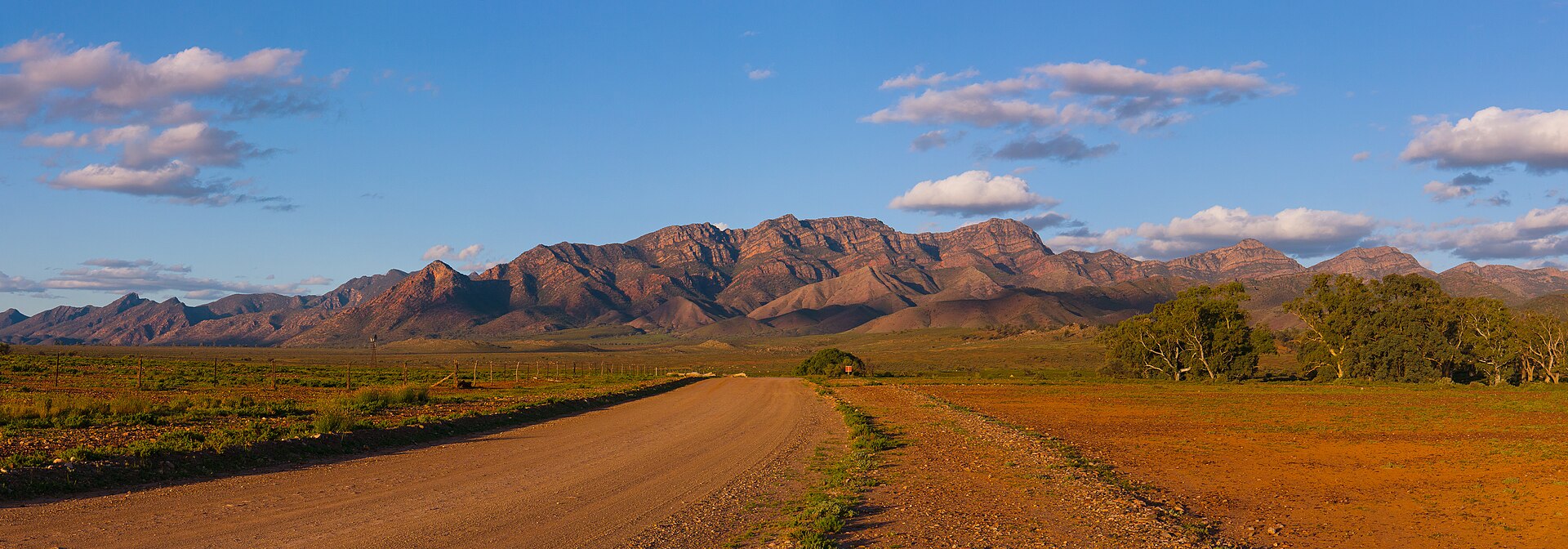
Rising from the red heart of South Australia, Ikara-Flinders Ranges National Park protects 95,000 hectares of serrated ridgelines, ancient gorges, and the spectacular natural amphitheatre of Wilpena Pound - a sickle-shaped basin covering nearly 80 square kilometres that has drawn people to its sheltered interior for tens of thousands of years. The park takes its name from the Adnyamathanha word "ikara", meaning "meeting place", a fitting description for a landscape that remains a living cultural home for the Adnyamathanha people, who co-manage the park alongside South Australia's National Parks and Wildlife Service. Geologically, it is one of the most significant places on Earth, containing a Global Boundary Stratotype Section and Point for the Ediacaran period - a marker in the rocks of Enorama Creek that records the dawn of complex multicellular life some 635 million years ago.
Wilpena Pound is the undisputed centrepiece of the park, a vast natural basin ringed by quartzite walls that rise sharply to form a near-complete enclosure visible from space. St Mary Peak, the highest point in the Flinders Ranges at 1,189 metres, crowns the northern rim and rewards walkers with a panorama stretching across fold upon fold of ancient hills. The Pound's interior is a contrasting world of shady creek flats lined with river red gums, native pines, and wildflowers that carpet the ground after winter rains. Early European settlers attempted to farm here, and the ruins of the old Wilpena Station homestead still stand near the visitor centre as a quiet reminder of how unforgiving this country can be.\n\nBeyond Wilpena Pound, the park unfolds into a series of dramatic gorges that cut through the ranges. Brachina Gorge and Bunyeroo Gorge offer a self-guided geological trail through rock layers that span hundreds of millions of years, with interpretive signs linking the roadside exposures to the story of the evolving Earth. The gorge walls glow amber and ochre in the late afternoon, and yellow-footed rock-wallabies can often be spotted picking their way across the boulder fields at dawn and dusk. Euro, red kangaroo, western grey kangaroo, echidna, goanna, and a rich diversity of raptors including the wedge-tailed eagle add to the wildlife spectacle.\n\nFor walkers, the park offers everything from short strolls to multi-day expeditions. The Heysen Trail and the Mawson Trail both pass through the park, drawing long-distance hikers and mountain bikers from across the country. Day walks range from the gentle Wangara Lookout walk to the strenuous but unforgettable St Mary Peak circuit, which climbs to the Pound's highest point and returns via the interior. The park also holds significant Aboriginal rock art sites and numerous cultural landscapes that Adnyamathanha rangers and guides bring to life on organised tours - an experience that adds an essential layer of understanding to any visit.\n\nThe geology beneath your boots is genuinely world-class. The park's Ediacaran GSSP, formally ratified by the International Commission on Stratigraphy in 2004, marks the boundary at the base of the Ediacaran period, the geological chapter that immediately precedes the explosion of animal life. The broader Flinders Ranges were inscribed on Australia's National Heritage List partly because of this scientific significance, and a formal nomination for UNESCO World Heritage status was submitted in 2021. Photographers find the park irresistible at dawn and dusk, when the low southern light sets the quartzite ridges alight with colour against skies that are almost entirely free of light pollution.
Scenic views
Lookouts near Ikara-Flinders Ranges National Park.
You may also like

Flinders Ranges and Wilpena Pound

Streaky Bay

Adelaide
Second Valley
Glenelg

Stonewell Road
Barossa Valley

Lake Eyre (Kati Thanda)

Clare Valley

Murray Bridge
Fleurieu Peninsula

Middleton
Attribution
Sources & credits
Content (1)
Images (3)
- 150906-001 Wilpena Pound from Moralana Scenic Drive Pano 50p... · Faj2323 · CC BY-SA 4.0
- Appealinna Ruins, Flinders Ranges 20230211 1.jpg · DXR · CC BY-SA 4.0
- Appealinna Ruins, Flinders Ranges 20230211 2.jpg · DXR · CC BY-SA 4.0


Images sourced from Wikimedia Commons under licenses that permit commercial use. If you are the rights holder and believe an attribution is incorrect, please contact us.