
Ningaloo Reef
Where the Desert Meets the Reef
On the lands of the Yinigurdira and Baiyungu people.
schedule 3 min read / Updated Apr 2026
A 260 kilometre fringing reef on the Coral Coast of Western Australia that begins right at the beach, so you can walk off the sand and into the reef without a boat. Ningaloo is UNESCO listed, home to the world's largest annual aggregation of whale sharks, and one of the only places on earth where you can swim with them reliably.
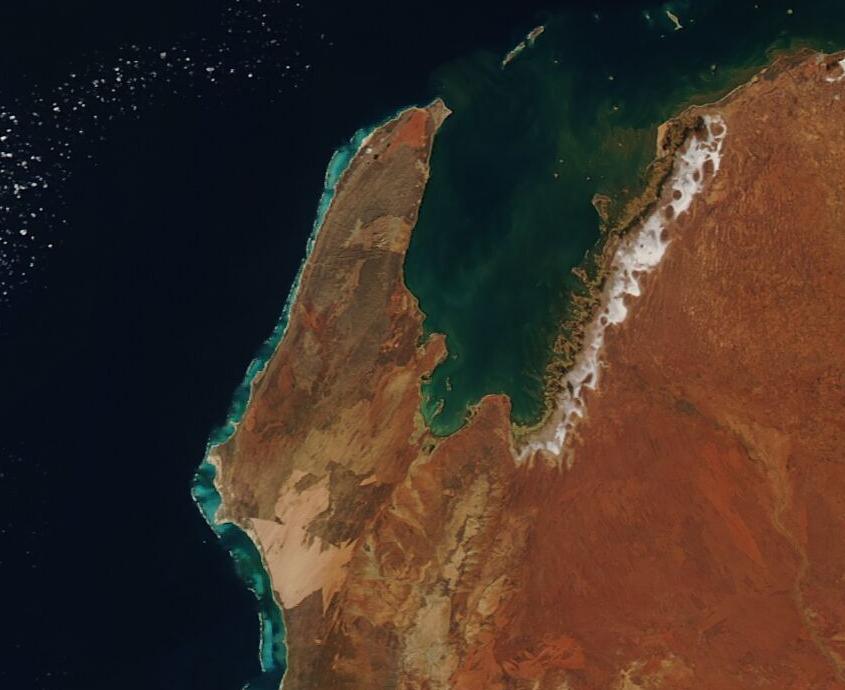
Ningaloo Reef runs along the western edge of the North West Cape in Western Australia, stretching roughly 260 kilometres from Red Bluff in the south to Exmouth Gulf in the north. Unlike the Great Barrier Reef, which sits far offshore and requires a boat to reach, Ningaloo is a fringing reef that comes right up against the shore. At many points you can wade or swim directly from the beach into healthy coral, which makes it one of the most accessible reef systems on earth.
The reef and its surrounding country were inscribed on the UNESCO World Heritage list in 2011 under the Ningaloo Coast listing, which also includes the Cape Range National Park behind it. The dual listing recognises both the marine diversity and the extraordinary karst landscape of the range, where limestone gorges, caves and underground rivers meet the reef within the span of a few kilometres. No other reef system on earth is backed by such a dramatic desert-and-range hinterland.
The reef's most famous residents are the whale sharks that aggregate off Ningaloo between March and August each year. The gathering is one of the largest and most predictable in the world, triggered by a mass coral spawning event in March that releases vast quantities of food into the water. Ningaloo is one of the only places on earth where visitors can reliably snorkel with whale sharks in open water, and the experience is tightly regulated by the Department of Biodiversity to protect the animals.
Beyond the whale sharks, Ningaloo is home to an estimated 500 species of fish, 300 species of coral, 650 species of mollusc, six of the seven species of marine turtle, and more than 2,000 sponges, echinoderms and crustaceans. Manta rays, humpback whales (July to November), dugongs, reef sharks and dolphins are all regular sightings. The reef's relative remoteness has kept it largely free of the mass bleaching events that have affected the Great Barrier Reef.
The two main bases are Exmouth at the northern tip and Coral Bay halfway down the coast. Exmouth is the larger town with more services, more operators, and proximity to the Cape Range National Park. Coral Bay is smaller, quieter, and closer to the prime whale shark and manta ray grounds, and its front beach opens directly onto a stretch of reef that is considered by some the best shore snorkelling in Australia.
Turquoise Bay, inside Cape Range National Park, is the most photographed beach on the coast. The current here gently drifts swimmers along a section of reef, so the typical experience is to walk 100 metres up the beach, swim out, and drift back to where you started. Yardie Creek Gorge, also inside the park, is the only place on the coast where sandstone cliffs plunge directly into a tidal river, and it is a reliable spot to see black-footed rock-wallabies from a boat cruise.
The best months to visit are April to October. March is when the whale shark season opens but the weather is still warm and humid. May to September has mild, dry days and cool nights, and is the standout period for most visitors. Cyclones are rare but possible between November and April, and the roads into Coral Bay can be briefly cut after rare heavy rains. Exmouth has its own airport with direct flights from Perth (2 hours) and occasional links to Broome and Darwin.
Common questions
Things visitors ask about Ningaloo Reef.
Quick answers to help you plan.
Where is Ningaloo Reef?
expand_more
Ningaloo Reef lies along the remote North West Cape of Western Australia, roughly 1,200 km north of Perth. It stretches for about 260 km along the coast next to Cape Range National Park, with Exmouth at the northern end and Coral Bay near the southern end.
How do I get to Ningaloo Reef?
expand_more
Most visitors fly into Learmonth Airport (LEA), about 35 km south of Exmouth, with daily Qantas flights from Perth taking around 2 hours. Driving from Perth covers roughly 1,270 km via the Brand and North West Coastal Highways and takes at least 13 to 14 hours, so it is usually broken into a 2-day trip.
Is there an entry fee for Cape Range National Park?
expand_more
Yes, Cape Range National Park charges a standard DBCA day entry fee per vehicle (up to 12 occupants). Frequent visitors can buy a Holiday Park Pass or an All Parks Annual Pass through the Parks and Wildlife Service, which covers entry to all fee-charging WA national parks.
When is whale shark season at Ningaloo?
expand_more
Whale sharks gather at Ningaloo each year from mid-March through to early August, after the autumn coral spawning. Licensed swim-with-whale-shark tours operate out of Exmouth and Coral Bay during this window and are the only legal way to enter the water with them.
What other marine life can I see, and when?
expand_more
Humpback whales migrate past Ningaloo from around June to early November, with swim-with-humpback tours running from August to October. Manta rays are present year-round but are most reliably seen at Coral Bay, and three species of marine turtle nest on the beaches between November and February, with hatchlings emerging from January to March.
Can you snorkel straight from the beach?
expand_more
Yes, Ningaloo is one of the few places in the world where a major fringing reef sits within easy swimming distance of shore. Turquoise Bay's drift snorkel and Oyster Stacks inside Cape Range National Park are the best-known spots, both reachable on foot from the car park with no boat required.
Should I base myself in Coral Bay or Exmouth?
expand_more
Exmouth is the larger town with an airport, hospital, supermarkets and the widest range of tour operators, and it is the gateway to Cape Range National Park. Coral Bay is a much smaller settlement built right on the reef, ideal if you want to walk from your accommodation straight onto the snorkel and to swim with manta rays.
When is the best time of year to visit Ningaloo?
expand_more
The cooler dry season from May to October offers warm sunny days, calm seas and the peak window for whale sharks and humpbacks, making it the most popular time. Summer (December to March) is hot and humid with the chance of tropical cyclones, but it is the season for turtle nesting and quieter beaches.
How does camping in Cape Range National Park work?
expand_more
All campgrounds inside Cape Range National Park are managed by DBCA and must be booked in advance through the Parks and Wildlife Service booking system. Sites for the peak winter season (around mid-May to early September) are released through a public ballot held the year before, as demand far exceeds the limited number of sites.
What makes Ningaloo unique?
expand_more
Ningaloo is the largest fringing coral reef in Australia and one of the few places on Earth where a reef of this scale runs so close to the mainland that you can snorkel directly from the beach. It is also globally significant for its annual aggregations of whale sharks, manta rays and migrating humpback whales.
Is Ningaloo a World Heritage area?
expand_more
Yes, the Ningaloo Coast was inscribed on the UNESCO World Heritage List in 2011 for its outstanding marine and terrestrial natural values. The listing covers the reef, the arid Cape Range peninsula and the surrounding marine park.
Gallery
Ningaloo Reef in pictures.
10 images licensed from Wikimedia Commons
All images are sourced from Wikimedia Commons under Creative Commons licences. Individual photographers are credited on the source pages.

Scenic views
Lookouts near Ningaloo Reef.
You may also like
Cape Range National Park

Coral Bay
Mandurah

Yanchep
Karijini National Park

Horizontal Falls

Mount Augustus

Kununurra

Bakers Hill
Cable Beach
Dowerin

Dunsborough
Attribution
Sources & credits
Content (5)
- Wikipedia: Ningaloo Reef · CC BY-SA 4.0
- Cape Range National Park · WA Department of Biodiversity, Conservation and Attractions
- Park entry fees · WA Department of Biodiversity, Conservation and Attractions
- Ningaloo Marine Park · WA Department of Biodiversity, Conservation and Attractions
- Ningaloo Coast - UNESCO World Heritage Centre · UNESCO World Heritage Centre · CC BY-SA 3.0 IGO
Images (10)
- Endless Stations 100 - The Road To Coral Bay.jpg · Ben Cordia · CC BY-SA 4.0
- North West Cape Peninsula, Australia (MODIS 2024-06-08).jpg · MODIS Land Rapid Response Team, NASA GSFC · Public domain
- .00 0975 Ningaloo Reef (Australia) - Surf on the coral reef.... · W. Bulach · CC BY-SA 4.0
- 00 0775 Küste - Ningaloo Reef, Western Australia.jpg · W. Bulach · CC BY-SA 4.0
- 00 0865 Ningaloo Reef, Western Australia.jpg · W. Bulach · CC BY-SA 4.0
- 00 1860. Ningaloo Reef - Westaustralien.jpg · W. Bulach · CC BY-SA 4.0
- 00 1870 Ningaloo Reef - Westaustralien.jpg · W. Bulach · CC BY-SA 4.0
- 00 2875 Western Australia - Ningaloo Reef.jpg · W. Bulach · CC BY-SA 4.0
- Cape Range National Park and Ningaloo Reef from the air.jpg · Andrew Turner · CC BY-SA 4.0
- Dugong family cruising the Ningaloo reef.jpg · Nicocolll · CC BY-SA 4.0

.jpg)
_-_Surf_on_the_coral_reef.jpg)


Images sourced from Wikimedia Commons under licenses that permit commercial use. If you are the rights holder and believe an attribution is incorrect, please contact us.