Ubirr
Where 18,000 years of living culture is painted across ancient stone
On the lands of the Bunitj and Manilakarr clans people.
schedule 3 min read / Updated Jun 2026
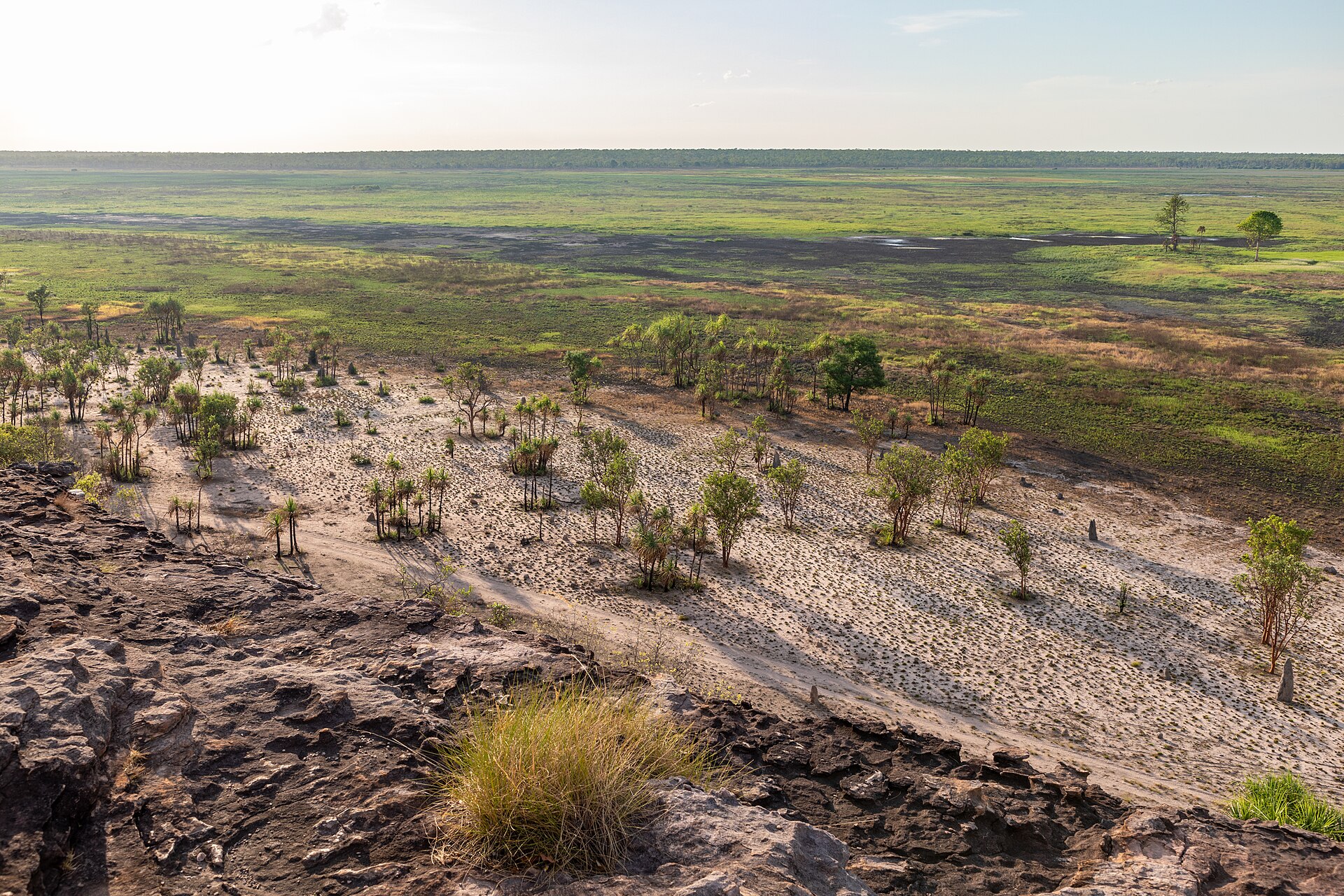
Ubirr is a dramatic sandstone rock formation on the edge of the Nadab floodplain in the East Alligator region of Kakadu National Park, sheltering one of the world's most remarkable concentrations of Aboriginal rock art. Painted and repainted over at least 18,000 years, the galleries document the full sweep of human experience in tropical Australia - from extinct megafauna and Mimi spirits to the arrival of European buffalo hunters in the 1880s. A climb to the lookout rewards visitors with a sweeping 360-degree panorama across the floodplains and stone country of Arnhem Land, best witnessed at sunset when the light turns the escarpment gold.
Ubirr sits within the traditional country of the Bunitj and Manilakarr clans, the custodians of this sacred place and the living interpreters of its art. The site's name and the paintings themselves are intrinsic to the clans' cultural law, passed down orally across generations. Kakadu National Park is jointly managed by the traditional owners and Parks Australia, and the presence of Indigenous rangers at Ubirr reflects an ongoing relationship between country and community that predates written history by tens of thousands of years.\n\nThe main art circuit is a 1 km loop track passing through several distinct galleries. The most celebrated is the Main Gallery, where X-ray paintings - showing the internal anatomy of barramundi, catfish, turtles, goannas and wallabies - date to within the last 1,500 years and speak to the abundant food resources of the freshwater period. Nearby, contact-period paintings depict a white figure in shirt and boots, likely a buffalo hunter from the 1880s, recorded by Indigenous artists with quiet precision. The Rainbow Serpent Gallery, a sacred site, carries creation-story imagery of profound spiritual importance and is treated with respect by visitors.\n\nPerhaps the most arresting image in the galleries is a painting of a thylacine - the Tasmanian tiger - placed here when the animal still roamed mainland Australia some 2,000 to 3,000 years ago. Its presence transforms the site from a historic record into a living ecological document, one that charts the slow disappearance of species alongside the enduring resilience of human culture. A separate steep 250-metre climb beyond the art trail leads to the rocky lookout, where the Nadab floodplain spreads to the horizon and Wilkins rock wallabies pick their way across the boulders.\n\nThe best time to visit Ubirr is during the dry season from May to October, when the sealed access road from Jabiru is reliable and the afternoon heat eases before sunset. The site opens from 2 pm daily and staying until dusk is strongly recommended - the fading light shifts the colours of the escarpment and the floodplain comes alive with birdlife, including blue-winged kookaburras and large flocks of magpie geese. During the tropical summer (November to April), road access is frequently cut by floodwaters at Magela Creek, but the Guluyambi boat cruise offers an alternative way to reach the site and includes guided cultural interpretation from Bunitj rangers.\n\nEntry to Ubirr is included with a Kakadu National Park pass, priced at $40 per adult in the dry season and $25 in the tropical summer (7-day pass, 2026 rates). The main art gallery area is flat, hardened and fully wheelchair accessible. Alcohol is prohibited at the site in accordance with the wishes of the traditional owners. Ubirr lies approximately 40 km from Jabiru along a sealed 2WD road, and around 288 km - roughly three hours' drive - east of Darwin via the Arnhem Highway.
Scenic views
Lookouts near Ubirr.
You may also like
Kakadu National Park
Kakadu National Park

Mataranka
West MacDonnell Ranges

Darwin

Chambers Pillar
Gunlom Falls

Kings Canyon

Tiwi Islands
Larapinta Trail
Litchfield National Park
Alice Springs
Attribution
Sources & credits
Content (1)
Images (3)
- Kakadu (AU), Kakadu National Park, Nadap Lookout -- 2019 --... · Dietmar Rabich · CC BY-SA 4.0
- Kakadu (AU), Kakadu National Park, Nadap Lookout -- 2019 --... · Dietmar Rabich · CC BY-SA 4.0
- Kakadu (AU), Kakadu National Park, Nadap Lookout -- 2019 --... · Dietmar Rabich · CC BY-SA 4.0
,_Kakadu_National_Park,_Nadap_Lookout_--_2019_--_4182.jpg)
,_Kakadu_National_Park,_Nadap_Lookout_--_2019_--_4200.jpg)
,_Kakadu_National_Park,_Nadap_Lookout_--_2019_--_4217.jpg)
Images sourced from Wikimedia Commons under licenses that permit commercial use. If you are the rights holder and believe an attribution is incorrect, please contact us.