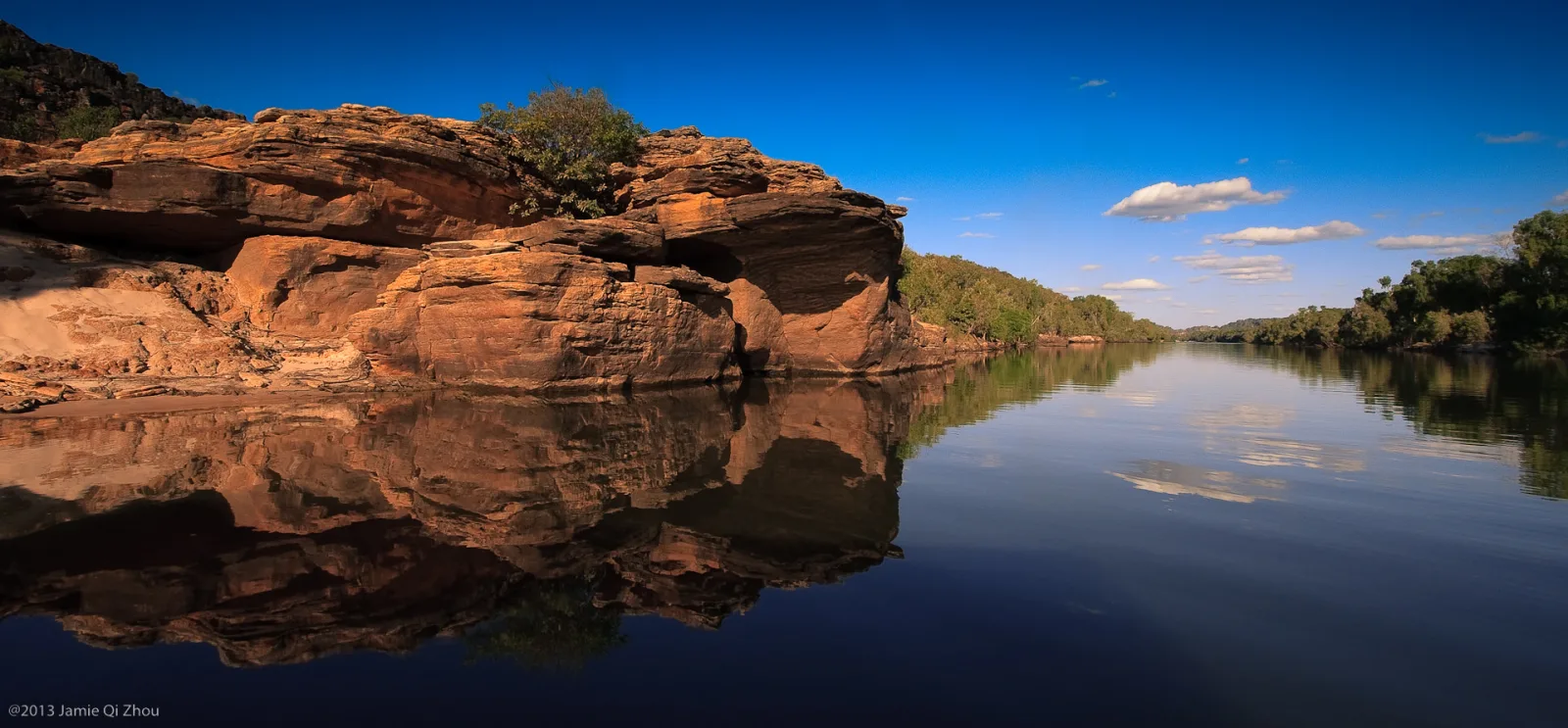
Kakadu National Park
Ancient Country, Living Culture
On the lands of the Bininj and Mungguy people.
schedule 3 min read / Updated Apr 2026
At almost 20,000 square kilometres, Kakadu is the largest national park in Australia and one of the few UNESCO sites on earth listed for both its natural and cultural values. It protects wetlands, sandstone escarpments, rock art galleries dating back 20,000 years and some of the richest biodiversity in the tropics.
Kakadu National Park sits 250 kilometres east of Darwin in the Top End of the Northern Territory. At 19,804 square kilometres it is almost half the size of Switzerland and is the largest national park in Australia. The park was first listed on the UNESCO World Heritage list in 1981 for its natural values, and the listing was extended in 1987 and 1992 to include its cultural values, making Kakadu one of only a handful of places on earth protected for both.
The park has been continuously inhabited by the Bininj and Mungguy people for at least 65,000 years, making it one of the longest continuously occupied landscapes on earth. Traditional owners still live in the park today, and their land councils jointly manage Kakadu with Parks Australia under an agreement that gives the traditional owners the majority voice. Most of the park's visitor activities are delivered through indigenous-owned tour operators, and the ranger-led cultural talks at places like Ubirr and Nourlangie are considered among the best indigenous tourism experiences in the country.
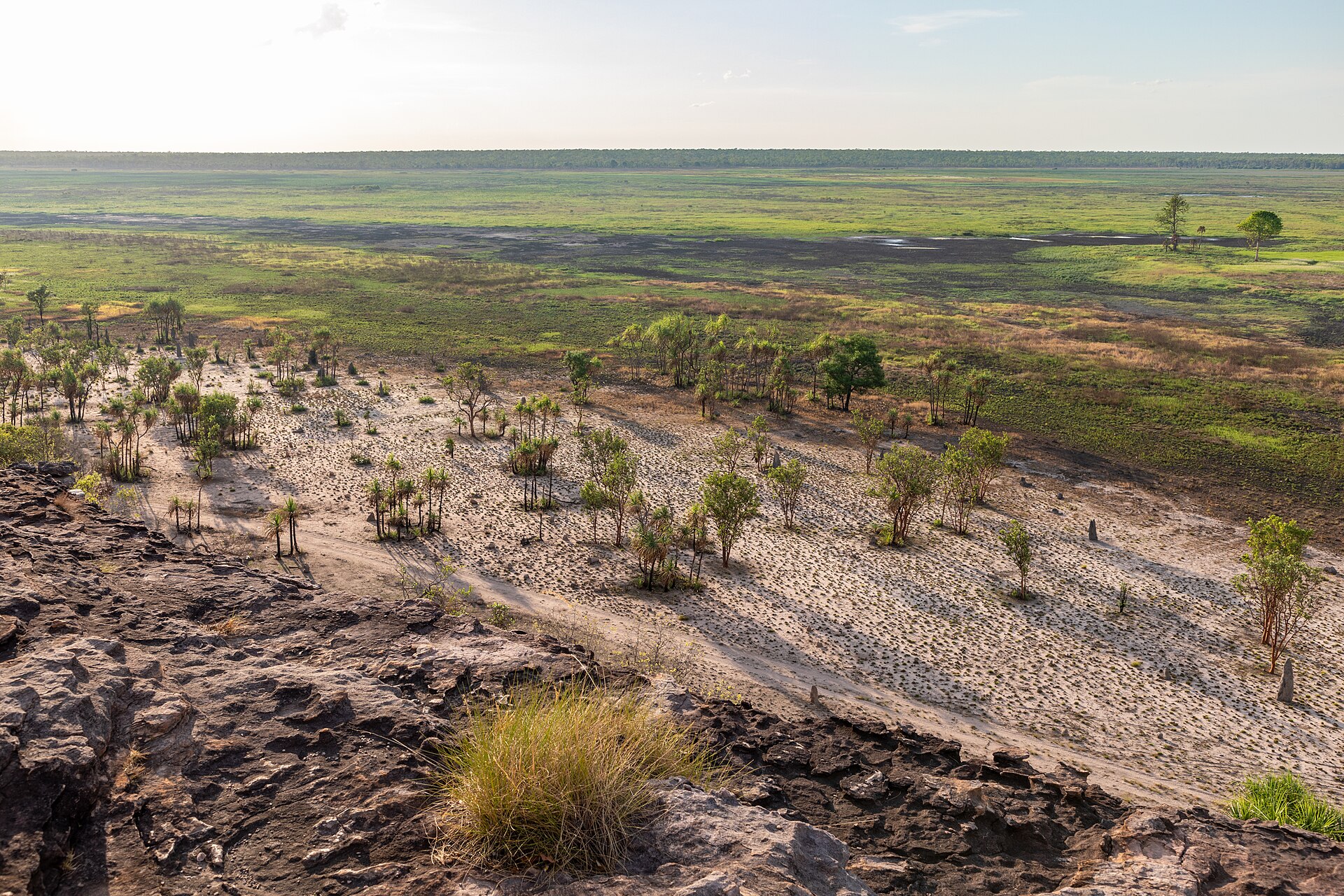
Kakadu contains more than 5,000 recorded rock art sites. Many of the paintings are 20,000 years old or older, with some individual paintings estimated at 28,000 years. The main publicly accessible galleries are at Ubirr, Nourlangie (also known as Burrungkuy) and Nanguluwurr, each with its own style and story. The paintings include depictions of the first European ships seen by local people, fish, kangaroos, goannas, and the x-ray style that shows the internal organs of animals alongside their external shape.
The park covers six distinct habitats: sandstone escarpments and outliers, savanna woodlands, monsoon rainforest, floodplains and billabongs, tidal mudflats and rivers, and stone country. This range of environments is why the park supports more than 2,000 plant species, 280 bird species (about one-third of all Australian bird species), 117 reptile species, 77 freshwater fish species, 74 mammal species and more than 10,000 insect species, many of them found nowhere else.
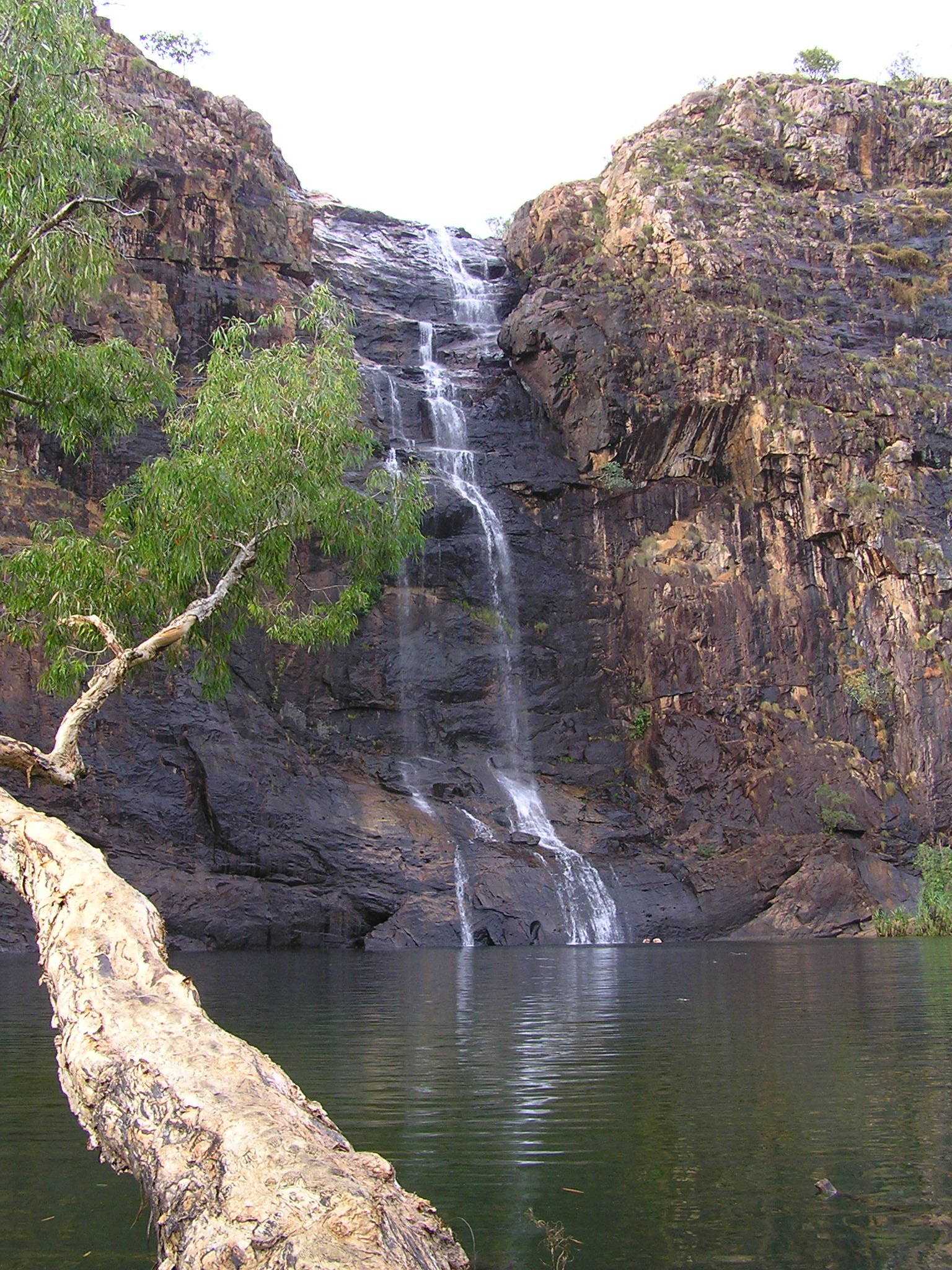
The two must-see waterfalls are Jim Jim Falls and Twin Falls. Jim Jim is a 200 metre single drop into a plunge pool surrounded by towering sandstone, and Twin Falls is a dual cascade into a sand-bottomed gorge. Both are only accessible in the dry season by four-wheel-drive and involve creek crossings, short walks and (for Twin Falls) a shuttle boat through a crocodile-inhabited section of the gorge. Maguk (Barramundi Gorge) and Gunlom are the other two major falls and are easier to access.
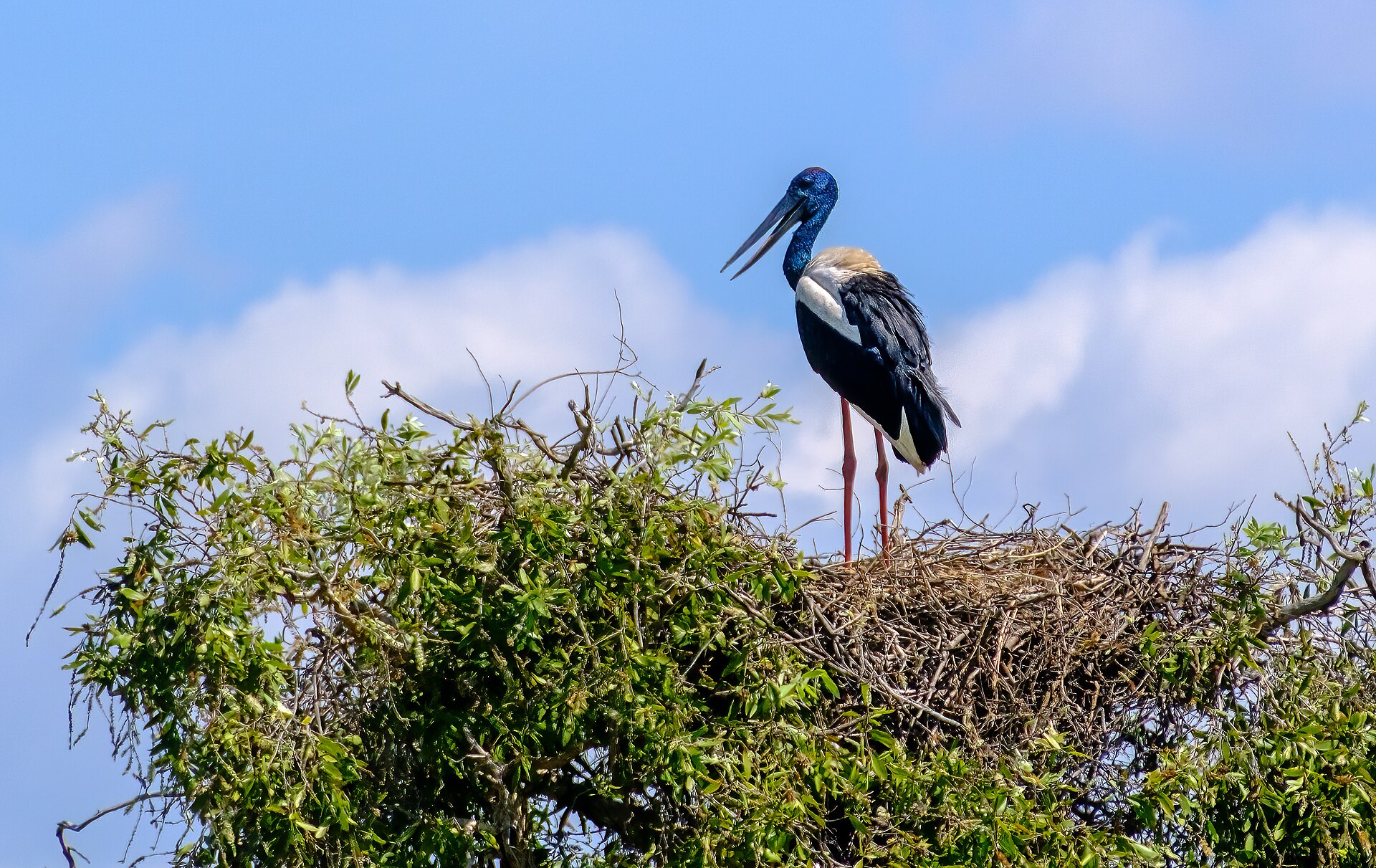
Yellow Water Cruises, operating from Cooinda near the south end of the park, run dawn and dusk boat trips through the Yellow Water wetlands. These cruises are the most reliable way to see saltwater crocodiles, jabirus, magpie geese, sea eagles and buffalo in the wild. Most visitors rank the sunrise cruise as the single best experience in Kakadu.
The park has two distinct seasons. The dry season runs from April to October and is when most visitors come, because roads and waterholes are accessible and the weather is warm and stable. The wet season (November to March) brings monsoon storms, raging waterfalls and dramatic lightning, but closes many of the four-wheel-drive tracks and can cut off entire sections of the park. Traditional owners recognise six seasons, not two, and the cultural centre at Warradjan explains the annual cycle in depth.
Common questions
Things visitors ask about Kakadu National Park.
Quick answers to help you plan.
How do I get to Kakadu from Darwin?
expand_more
Kakadu is about 250km east of Darwin via the Stuart and Arnhem highways, a drive of roughly three hours to the park boundary. The main sealed routes are 2WD friendly, but check the Kakadu Access Report before you set off because some side roads close seasonally. You can self-drive, hire a 4WD or motorhome, or join a bus or 4WD tour from Darwin.
How much does it cost to enter Kakadu National Park?
expand_more
A 7-day adult park pass is $40 in the dry season (15 May to 31 October) and $25 in the tropical summer (1 November to 14 May). Children aged 5 to 15 pay $20 in the dry and $12.50 in the summer, and kids under 5 are free. Buy your pass online at kakadu.gov.au before you arrive, or in person at the Bowali Visitor Centre, Cooinda Lodge or several other outlets.
When is the best time of year to visit Kakadu?
expand_more
The dry season from May to October is the most popular window, with sunny days, low humidity and almost every site open including the major waterfalls. The tropical summer from November to April brings electric storms, vivid green floodplains and far fewer visitors, though some roads and gorges close. Year-round favourites like Yellow Water, Burrungkuy and the rock art galleries stay accessible in both seasons.
How many days do I need in Kakadu?
expand_more
Parks Australia recommends at least 3 days to take in the highlights, with their full Kakadu Adventure itinerary running over 5 days. Plan on 5 to 7 days if you want to reach the southern waterfalls, do a Yellow Water cruise and slow down at the rock art sites. Two days is workable as a fly-through, but the park covers nearly 20,000 square kilometres so distances eat into your time.
Is it safe to swim in Kakadu, with all the crocodiles?
expand_more
Saltwater crocodiles live in most waterways across Kakadu, including freshwater billabongs more than 200km inland, so never swim unless a sign confirms the area has been surveyed and opened for that season. The safest swims are in your hotel or campground pool, or in the escarpment plunge pools that rangers check each dry season. Stay at least 5 metres back from any water's edge, camp 50 metres away from water, and assume crocs are present even where there are no signs.
What is the Yellow Water cruise and is it worth doing?
expand_more
Yellow Water (Ngurrungurrudjba) is a wetland billabong near Cooinda that runs guided boat cruises year-round through some of the densest birdlife and saltwater crocodile habitat in the park. It is the safest and closest way to see large wild crocs, jabirus, sea eagles and lotus lilies up close. Sunrise and sunset cruises are the most popular and tend to book out in the dry, so reserve ahead through Cooinda Lodge.
Where are the main Aboriginal rock art sites?
expand_more
The two flagship galleries are Ubirr in the East Alligator region and Burrungkuy (formerly Nourlangie) in the central park, both 2WD accessible when open. Some paintings are up to 20,000 years old, making this one of the longest continuous artistic records on Earth, with x-ray art, contact art of European sailing ships and creation beings like Namarrkon the Lightning Man. Both sites are free with your park pass and have well-marked walking circuits.
Who manages Kakadu and what does joint management mean?
expand_more
Kakadu is Aboriginal land jointly managed by the Bininj and Mungguy Traditional Owners and Parks Australia, under a lease arrangement that has run since the late 1970s. The Board of Management has an Aboriginal majority and combines traditional knowledge with modern science to care for Country. Bininj/Mungguy connection to this landscape stretches back more than 65,000 years, which is why Kakadu is dual-listed by UNESCO for both natural and cultural values.
Where can I stay inside Kakadu?
expand_more
Jabiru in the north has the Mercure Kakadu Crocodile Hotel (the croc-shaped one) and Anbinik Kakadu Resort, while Cooinda Lodge near Yellow Water offers hotel rooms, glamping tents and a large caravan park. Kakadu also has campgrounds across seven regions of the park, ranging from free bush sites to facilities with showers and toilets. Most campsites are first-come first-served, so arrive early in peak dry season.
Do I need a 4WD to see Jim Jim and Twin Falls?
expand_more
Yes, Jim Jim Falls and Twin Falls are 4WD-only, with a high-clearance vehicle and a snorkel recommended for the Jim Jim Creek crossing. The track is open in the dry season once water levels drop, typically reopening around June and closing again with the first big rains. If you are in a 2WD, book a guided day tour from Cooinda or take a scenic flight, which is the only way to see the falls in full flow during the wet.
What cultural rules should I follow when visiting?
expand_more
Stay on marked tracks and respect any signs marking sacred or restricted areas, which are off limits to visitors. Do not photograph Bininj/Mungguy people without asking first, and avoid photographing certain art panels where signs request it. A simple "bobo" is the local way to say goodbye when you leave Country.
Gallery
Kakadu National Park in pictures.
10 images licensed from Wikimedia Commons
All images are sourced from Wikimedia Commons under Creative Commons licences. Individual photographers are credited on the source pages.
On the itinerary
Trip plans that include Kakadu National Park.


Featured in
Shortlists that include Kakadu National Park.


From the journal
Read more about Kakadu National Park.

Guide · 4 min read
The Best Time to Visit Australia
Australia is too big for a single 'best time'. The right month depends entirely on where you are going and what you want to see. Here is the full calendar.

Guide · 2 min read
Weather and When to Go
Australia spans almost 4,000 kilometres north to south, from the tropics to the temperate cool. The right season for one half of the country is the wrong one for the other.

Guide · 4 min read
Camping and National Parks
Australia has more than 500 national parks and thousands of reserve campgrounds, but the rules vary by state. Here is the practical overview.
Scenic views
Lookouts near Kakadu National Park.
You may also like
Gunlom Falls
Mary River National Park
Kakadu National Park
Ubirr
Larapinta Trail

Nitmiluk National Park

Kings Canyon

Devils Marbles (Karlu Karlu)
Hermannsburg and Finke Gorge
Litchfield National Park

Mount Conner (Atila)
Watarrka National Park
Attribution
Sources & credits
Content (6)
- Wikipedia: Kakadu National Park · CC BY-SA 4.0
- Park passes - Kakadu National Park · Parks Australia · CC BY 4.0
- When to come - Kakadu National Park · Parks Australia · CC BY 4.0
- Culture - Kakadu National Park · Parks Australia · CC BY 4.0
- Crocodiles - Kakadu National Park · Parks Australia · CC BY 4.0
- Rock art - Kakadu National Park · Parks Australia · CC BY 4.0
Images (10)
- East Alligator River (47540700).jpeg · Jamie Qi Zhou · CC BY 3.0
- Kakadu (AU), Kakadu National Park, Cahills Crossing -- 2019... · Dietmar Rabich · CC BY-SA 4.0
- Kakadu (AU), Kakadu National Park, Cahills Crossing -- 2019... · Dietmar Rabich · CC BY-SA 4.0
- Kakadu (AU), Kakadu National Park, Gunwarrdehwarrde Lookout... · Dietmar Rabich · CC BY-SA 4.0
- Kakadu (AU), Kakadu National Park, Gunwarrdehwarrde Lookout... · Dietmar Rabich · CC BY-SA 4.0
- Kakadu (AU), Kakadu National Park, Gunwarrdehwarrde Lookout... · Dietmar Rabich · CC BY-SA 4.0
- Kakadu (AU), Kakadu National Park, Nadap Lookout -- 2019 --... · Dietmar Rabich · CC BY-SA 4.0
- Kakadu (AU), Kakadu National Park, Nadap Lookout -- 2019 --... · Dietmar Rabich · CC BY-SA 4.0
- Kakadu (AU), Kakadu National Park, Nadap Lookout -- 2019 --... · Dietmar Rabich · CC BY-SA 4.0
- Kakadu (AU), Kakadu National Park, Nadap Lookout -- 2019 --... · Dietmar Rabich · CC BY-SA 4.0
.jpeg)
,_Kakadu_National_Park,_Cahills_Crossing_--_2019_--_4160.jpg)
,_Kakadu_National_Park,_Cahills_Crossing_--_2019_--_4153.jpg)
,_Kakadu_National_Park,_Gunwarrdehwarrde_Lookout_--_2019_--_4118.jpg)
,_Kakadu_National_Park,_Gunwarrdehwarrde_Lookout_--_2019_--_4124.jpg)
,_Kakadu_National_Park,_Gunwarrdehwarrde_Lookout_--_2019_--_4128.jpg)
,_Kakadu_National_Park,_Nadap_Lookout_--_2019_--_4180.jpg)
,_Kakadu_National_Park,_Nadap_Lookout_--_2019_--_4182.jpg)
,_Kakadu_National_Park,_Nadap_Lookout_--_2019_--_4190.jpg)
,_Kakadu_National_Park,_Nadap_Lookout_--_2019_--_4191.jpg)
Images sourced from Wikimedia Commons under licenses that permit commercial use. If you are the rights holder and believe an attribution is incorrect, please contact us.