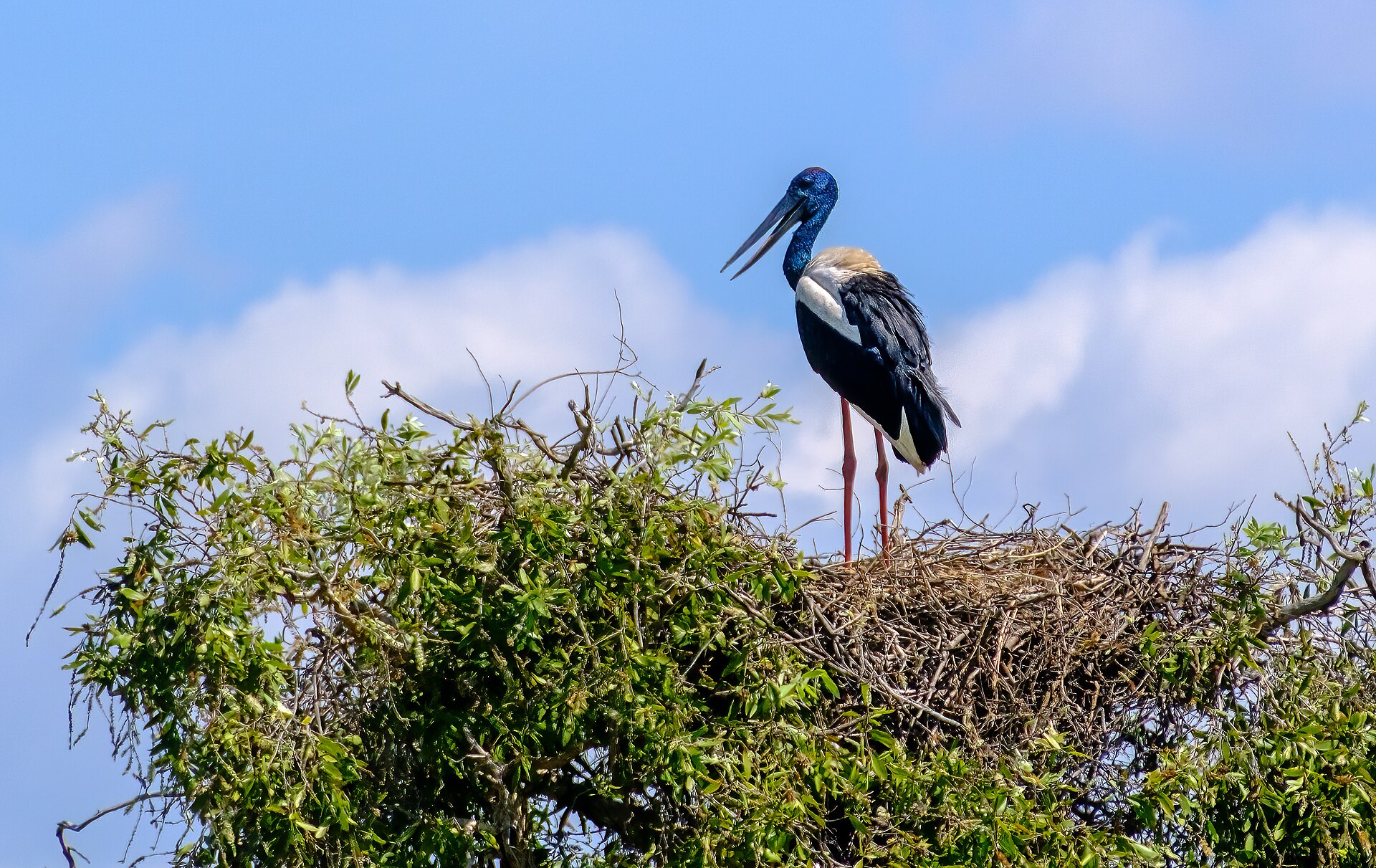
Mary River National Park
One of the world's greatest crocodile strongholds - a vast Top End wetland teeming with prehistoric life.
On the lands of the Limilngan, Wulna and Uwynmil peoples people.
schedule 2 min read / Updated Jun 2026
Mary River National Park stretches across 1,215 square kilometres of tropical floodplain, paperbark swamp, and monsoon woodland roughly 150 kilometres east of Darwin - a raw, watery wilderness that ranks among Australia's most extraordinary wildlife destinations. The park's billabongs and river channels support up to 15 saltwater crocodiles per kilometre, a density that rivals anywhere on Earth, while the surrounding wetlands provide refuge for more than 250 bird species including the world's largest breeding colony of magpie geese. Jointly managed with the Limilngan, Wulna and Uwynmil peoples whose ancestors have shaped this country for thousands of years, Mary River rewards those willing to venture beyond Kakadu's well-worn tracks.
The centrepiece of a visit is Shady Camp, where the tidal barrage at the edge of the floodplain concentrates saltwater crocodiles in numbers that must be seen to be believed. At dawn, when flat light silvers the water and magpie geese lift in their hundreds from the lotus lilies, this is genuinely one of the great wildlife spectacles in the Southern Hemisphere. Boat access is the best way to absorb it all - guided wetland cruises and self-launched tinnies share the water with ancient reptiles of up to five metres, and the experience is humbling in a way no zoo or documentary can replicate.\n\nCorroboree Billabong, reached via Point Stuart Road off the Arnhem Highway, offers a quieter but equally rewarding angle on the wetlands. Floating mats of water lilies stretch to the tree line, jabiru stalk the shallows, and freshwater crocodiles sun themselves on mud banks alongside their much larger saltwater cousins. The area has been identified as part of the Adelaide and Mary River Floodplains Important Bird Area, and serious birdwatchers routinely record over 100 species in a single morning here.\n\nOn land, the park offers walks ranging from a gentle 2-kilometre stroll through paperbark woodland to the challenging 6-kilometre return route to Stuart's Memorial Cairn, which commemorates explorer John McDouall Stuart's 1862 passage through the Top End. Most unsealed tracks require a high-clearance 4WD, and many close entirely during the wet season when floodwaters reclaim the landscape - a reminder of how dynamic and seasonally extreme this environment truly is.\n\nThe park is jointly managed by the Northern Territory Parks and Wildlife Commission and the Limilngan, Wulna and Uwynmil peoples, who have inhabited and cared for this country since long before European contact. The 2015 joint management plan incorporates cultural narratives from traditional owners and recognises more than 20 sacred sites within park boundaries. Visitors are encouraged to approach the landscape with this deep cultural context in mind - what looks like empty floodplain to an outside eye is, in fact, a living cultural map.\n\nFor wildlife photographers, the combination of accessible water, reliable animal sightings, and dramatic tropical light - particularly in the golden hours around sunrise - makes Mary River one of the most productive locations in Australia. The dry season from May to October is the only practical time for most visitors, but those who time an early-wet-season visit in November may witness the first storms rolling across the floodplain: a spectacle of electricity and scale that few places on the continent can match.
Scenic views
Lookouts near Mary River National Park.
You may also like
Kakadu National Park

Darwin

Mindil Beach

Nitmiluk National Park
Larapinta Trail

Mount Conner (Atila)
Standley Chasm

Daly Waters

Katherine

Chambers Pillar
Alice Springs

Litchfield National Park
Attribution
Sources & credits
Content (1)
Images (3)
- Black Necked Stork in Mary River National Park (NT).jpg · Longboardfella · CC BY-SA 4.0
- Brolga with flower in Mary River National Park (NT).jpg · Longboardfella · CC BY-SA 4.0
- Cacatua sanguinea -Mary River National Park, Northern Territ... · Lip Kee Yap from Singapore, Republic of Singapore · CC BY-SA 2.0
.jpg)
.jpg)

Images sourced from Wikimedia Commons under licenses that permit commercial use. If you are the rights holder and believe an attribution is incorrect, please contact us.