
Blue Mountains
Eucalypt Haze and Sandstone Cliffs
schedule 3 min read / Updated Jun 2026
A sandstone plateau two hours west of Sydney where eucalypt forests, deep gorges and waterfalls stretch for more than 100 kilometres. The Blue Mountains are named for the haze that hangs over the valleys, caused by the volatile oils released by the eucalyptus trees and scattered by sunlight.
The Blue Mountains form the eastern edge of the Great Dividing Range, covering an area of over 10,000 square kilometres roughly 50 kilometres west of Sydney's CBD. Despite the name, the plateau is not a mountain range in the conventional sense. It is a raised sandstone plateau cut through with deep canyons by millions of years of erosion, and the highest points barely clear 1,200 metres. The effect from the valley floor, however, is of towering walls on every side.
The signature blue haze comes from eucalyptus oil. The forest here is overwhelmingly dominated by eucalypts, which release volatile terpene compounds into the air on warm days. These compounds scatter the blue wavelengths of sunlight in the same way that the atmosphere scatters light to give the sky its colour, producing the distinctive blue tinge that gives the mountains their name. The phenomenon was noted by the British in 1788, years before the actual mountains were explored.
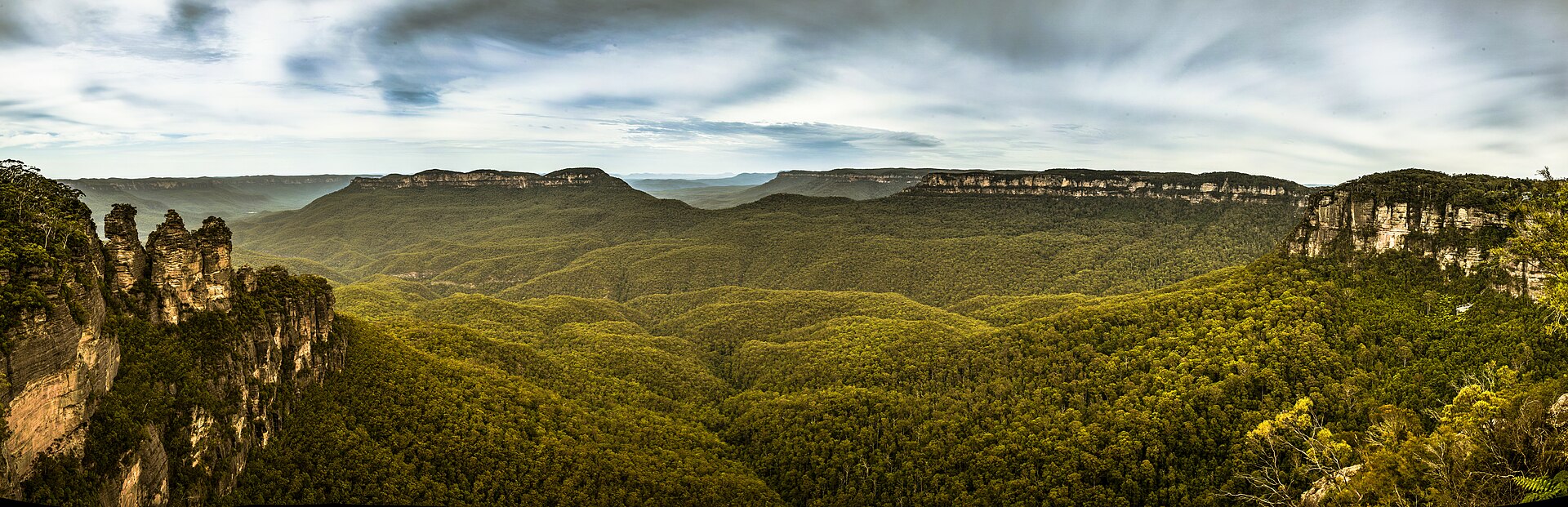
The traditional owners are the Darug and Gundungurra people, whose stories explain many of the landscape features. The most famous of these is the Three Sisters, a set of three sandstone pillars at Echo Point in Katoomba. The Gundungurra story tells of three sisters named Meehni, Wimlah and Gunnedoo who were turned to stone to protect them from a bunyip, and then could not be restored when the elder who cast the spell was killed before he could reverse it. The pillars are the most photographed landmark in the mountains and are lit at night.
The region was first crossed by Europeans in 1813, when Gregory Blaxland, William Lawson and William Charles Wentworth found a route across the ridge lines that led to the grazing country of the Bathurst plains beyond. Before that, the mountains were considered impassable by the settlers and were a natural barrier that contained the colony to the east coast for 25 years.
Katoomba is the largest town and the usual base for visitors. Scenic World, on the edge of the Jamison Valley, has the world's steepest passenger railway (a 52-degree incline) that descends into the valley floor, plus a cable car and skyway that cross the gorge at different angles. From the valley floor, short walking tracks lead to the base of Katoomba Falls and past the Three Sisters. Nearby Leura is a quieter alternative with a strong cafe and garden scene.
The park offers everything from 20 minute lookout strolls to multi-day wilderness hikes. The Grand Canyon track at Blackheath is a 6 kilometre loop through a slot canyon that many consider the best half-day walk in the country. The Federal Pass between the Giant Stairway and the Scenic Railway is a longer full-day walk along the base of the valley. For experienced canyoners, the Wollangambe, Empress and Claustral slot canyons in the Upper Blue Mountains are internationally regarded.
The best months to visit are April to May and September to November, when temperatures are mild, waterfalls are flowing and the crowds have thinned out. Winter (June to August) can be surprisingly cold, with occasional snow above 900 metres, and summer (December to February) brings afternoon thunderstorms. The mountain railway from Sydney Central Station to Katoomba takes about two hours and is the easiest car-free way to visit.
Common questions
Things visitors ask about Blue Mountains.
Quick answers to help you plan.
How do I get to the Blue Mountains from Sydney?
expand_more
The easiest option is the NSW TrainLink Blue Mountains Line from Sydney Central, which reaches Katoomba in about two hours with services running at least every hour. Tap on with an Opal card or contactless credit/debit card. Driving via the M4 and Great Western Highway also takes about 90 minutes to two hours depending on traffic.
Is there an entry fee for Blue Mountains National Park?
expand_more
Most of the park is free to enter, including the Katoomba and Blackheath areas. A vehicle entry fee of $8 per vehicle per day applies only at attractions in the Glenbrook area in the lower Blue Mountains. Paid parking meters operate at Echo Point lookout in Katoomba from 9am to 5pm daily, with a minimum charge of $4.40 for the first hour.
Can I see the Blue Mountains as a day trip or should I stay overnight?
expand_more
A day trip from Sydney works well if you focus on Katoomba, Echo Point and one short walk, and most rail visitors do exactly that. Staying one or two nights lets you tackle a longer track like the Grand Canyon or National Pass, see the Three Sisters floodlit at night, and explore Leura and Blackheath at a slower pace.
Where is the best place to see the Three Sisters?
expand_more
The classic view is from Echo Point lookout in Katoomba, about 2.5km from the Great Western Highway. The three sandstone peaks stand at 922, 918 and 906 metres tall and are floodlit until around 11pm each evening. The top platform is step-free and there is a council visitor centre on site, open daily 9am to 4pm.
How much does Scenic World cost and what is included?
expand_more
The Unlimited Discovery Pass starts at $61 for adults and gives you all-day unlimited rides on the Scenic Railway (the world's steepest passenger railway), the Scenic Cableway and the Scenic Skyway, plus access to the boardwalk trails on the Jamison Valley floor and Dinosaur Valley. Booking online in advance gets the best price.
What are the best walks in the Blue Mountains?
expand_more
The Grand Canyon track at Blackheath is a 6.3km loop taking 3 to 4 hours through rainforest, waterfalls and sandstone walls. National Pass at Wentworth Falls is a clifftop classic, though sections may be closed due to rockfall, so always check current conditions. The Grand Cliff Top Walk runs 11km one-way from Wentworth Falls to Katoomba and takes 5 to 7 hours.
When is the best time of year to visit?
expand_more
Autumn (March to May) is a favourite for cooler walking weather and rich amber and red foliage in towns like Blackheath and Leura. Winter brings frost, fireplaces and the Yulefest celebrations through June, July and August, though actual snow only falls about 5 days a year in the upper mountains. Summer is warmer and busy, but it is also peak bushfire season, so check fire warnings before heading out.
Is bushfire a risk and what should I check?
expand_more
The official bush fire danger period in the Blue Mountains runs from 1 September to 31 March, and parts of the park can close on days of extreme fire weather. Before visiting in summer, check the NSW National Parks alerts page, the Hazards Near Me app and the NSW Rural Fire Service for Total Fire Bans and current fire danger ratings. On a Total Fire Ban day no open fires, solid fuel barbecues or stoves are permitted in the park.
Where should I stay in the Blue Mountains?
expand_more
Katoomba is the most central base, with hotels, hostels and motels close to the train station, Echo Point and Scenic World. Leura is quieter and known for its boutique cottages, cafes and gardens, just a few minutes from Katoomba. Blackheath sits higher and further west, with heritage guesthouses and easy access to Govetts Leap and the Grand Canyon track.
Why are they called the Blue Mountains?
expand_more
The blue haze comes from the eucalyptus forests that blanket the ranges. Fine droplets of eucalyptus oil released by the trees combine with dust and water vapour in the air and scatter short-wavelength light, which appears predominantly blue. Governor Phillip first named the range the Carmarthen and Landsdowne Hills in 1788, but the distinctive colour soon won out.
Whose Country are the Blue Mountains on?
expand_more
The Greater Blue Mountains World Heritage Area is the traditional Country of six Aboriginal nations: the Darug, Gundungurra, Wiradjuri, Wanaruah, Darkinjung and Tharawal peoples. The Three Sisters at Echo Point sit within a declared Aboriginal Place, and the Gathering Place amphitheatre there was built in consultation with Darug and Gundungurra elders. Cultural sites you can visit include Red Hands Cave at Glenbrook, with hand stencils painted between 500 and 1,600 years ago.
Tourist locations
Places to visit in Blue Mountains.
7 locations to explore
Echo Point Lookout
Clifftop views over the valley
Free
Full guide arrow_forwardEverglades House and Gardens
Art Deco garden above the valley
$17 adult, $15 concession, $49 family; National Trust members free
Full guide arrow_forwardGovetts Leap Lookout
Grose Valley's grand amphitheatre
Free
Full guide arrow_forwardKatoomba Falls Reserve
Dramatic cascades above the escarpment
Free
Full guide arrow_forwardLeura Cascades
Fern-lined falls and rainforest
Free
Full guide arrow_forwardLincoln's Rock
Sunset views over the Jamison Valley
Free
Full guide arrow_forwardNorman Lindsay Gallery
Art and myth in the mountains
$17 adult, $15 concession, $49 family; National Trust members free
Full guide arrow_forwardGallery
Blue Mountains in pictures.
11 images licensed from Wikimedia Commons
All images are sourced from Wikimedia Commons under Creative Commons licences. Individual photographers are credited on the source pages.
Featured in
Shortlists that include Blue Mountains.

From the journal
Read more about Blue Mountains.
Guide · 3 min read
Australia's Best Lookouts, State by State
From sandstone escarpments to volcanic plugs and red-rock gorges, here are the lookouts worth the detour in every state, plus how to find the ones closest to you.

Guide · 4 min read
The Best Time to Visit Australia
Australia is too big for a single 'best time'. The right month depends entirely on where you are going and what you want to see. Here is the full calendar.
Scenic views
Lookouts near Blue Mountains.
You may also like




Attribution
Sources & credits
Content (6)
- Wikipedia: Blue Mountains · CC BY-SA 4.0
- Blue Mountains National Park: visitor info · NSW National Parks and Wildlife Service
- Echo Point lookout (Three Sisters) · NSW National Parks and Wildlife Service
- Gundungurra joint management program · NSW National Parks and Wildlife Service
- Unlimited Discovery Pass · Scenic World
- Visit Blue Mountains by train · Transport for NSW
Images (11)
- Bleichert Mining Bucket in the Blue Mountains, near Katoomba... · Invenio · CC BY-SA 4.0
- Blue Mountains National Park (AU), Three Sisters -- 2019 --... · Dietmar Rabich · CC BY-SA 4.0
- Blue mountains - three sisters.jpg · CC BY-SA 2.5
- Blue Mountains, Australia.jpg · CC BY-SA 3.0
- Blue Mountains NSW Australia.jpg · Kanzcech · CC BY-SA 4.0
- Blue Mountains National Park (AU), Jamison Valley -- 2019 --... · Dietmar Rabich · CC BY-SA 4.0
- Blue Mountains National Park (AU), Jamison Valley -- 2019 --... · Dietmar Rabich · CC BY-SA 4.0
- Blue Mountains National Park (AU), Jamison Valley -- 2019 --... · Dietmar Rabich · CC BY-SA 4.0
- Blue Mountains National Park (AU), Jamison Valley -- 2019 --... · Dietmar Rabich · CC BY-SA 4.0
- Blue Mountains National Park (AU), Three Sisters -- 2019 --... · Dietmar Rabich · CC BY-SA 4.0
- Blue Mountains National Park (AU), Three Sisters -- 2019 --... · Dietmar Rabich · CC BY-SA 4.0

,_Three_Sisters_--_2019_--_1987-9.jpg)


,_Jamison_Valley_--_2019_--_1874.jpg)
,_Jamison_Valley_--_2019_--_1883-9.jpg)
,_Jamison_Valley_--_2019_--_1900.jpg)
,_Jamison_Valley_--_2019_--_2016.jpg)
,_Three_Sisters_--_2019_--_1946.jpg)
,_Three_Sisters_--_2019_--_1983.jpg)
Images sourced from Wikimedia Commons under licenses that permit commercial use. If you are the rights holder and believe an attribution is incorrect, please contact us.